Application Note

Designing Two-Phase Devices for Performance

What Physics Rewards. What It Punishes.

Performance is not optimized it is allocated. Every constraint spends margin somewhere. If you don’t know where, physics will decide for you.

Geometry & Sizing

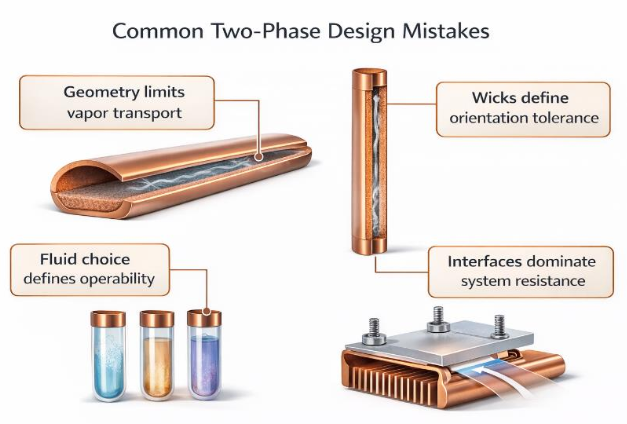
Performance starts with cross-section.

  • Cross-section is the highest-value asset.
  • Thickness beats width. Every time.
  • Short paths outperform clever spreading.

Punishments

  • Heat spreading does not replace vapor area.
  • Minimum envelopes do not produce high performance.
  • Late packaging changes always cost margin.

Reality check

A 20–30% hit in thickness commonly changes the governing limit.


Flattening & Forming

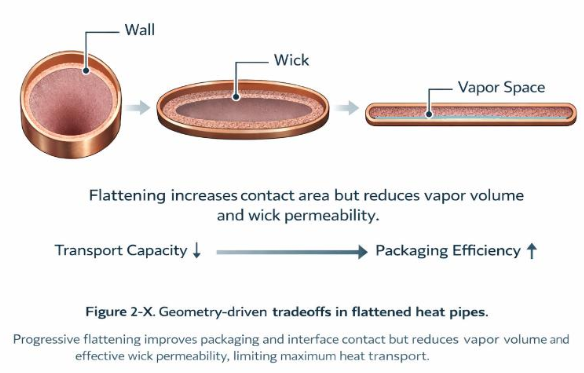
Flattening is a trade, not a win.

  • Contact improves.
  • Vapor and liquid-return margin shrink.
  • Wick damage is real.

Punishments

  • Flattening does not increase capacity.
  • Round-tube assumptions lie once you flatten.

Rule

Flattened height ≤50–60% of OD is where vapor transport and wick effects take over.

Wick & Liquid Return

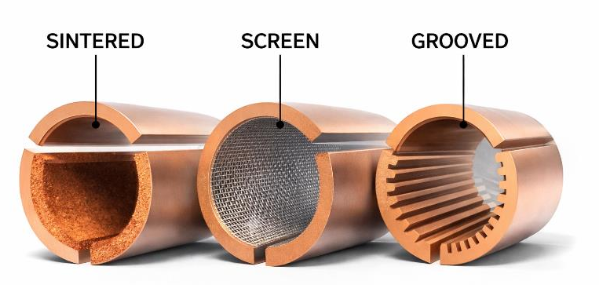
Capillary limit kills more designs than anything else.

  • Orientation matters even when you wish it didn’t.
  • Capillary pressure without flow margin still fails.

Punishments

  • Ideal wick properties do not survive reality.
  • Manufacturing, bending, and forming reduce permeability.

Truth

In real hardware, the capillary limit is often the governing limit.

Vapor Space & Transport

Vapor space is not optional.

  • Vapor cross-section sets capacity.
  • ΔP rises fast with flattening and bending.

Punishments

  • Vapor space treated as leftover volume disappears first.
  • Transport limits dominate long, thin, flat geometries.

Truth

Long + thin + flat becomes vapor-limited. Always.

Bending & Routing

Every bend spends margin.

  • Bends ovalize tubes.
  • Wicks distort.
  • Vapor area shrinks.

Punishments

  • Straight-tube performance does not survive routing.
  • Stacked bends behave like restrictions.

Rules

  • R ≥ 5×OD → minimal penalty
  • R ≥ 3×OD → measurable penalty
  • R < 3×OD → expect degradation
  • Bends within ~5×OD compound losses
  • Bends near the evaporator are high risk

Length & Aspect Ratio

Length eats capillary pressure for lunch.

  • Transport penalties scale faster than length alone.
  • Capillary head is finite length consumes it directly.

Punishments

  • Short-device data does not extrapolate.
  • Condenser area does not save long evaporators.

Truth

If L/OD looks uncomfortable on the drawing, it already is.

Heat Input & Evaporator

The hottest square centimeter sets the ceiling.

  • Heat input is non-uniform unless proven otherwise.
  • Total watts is a distraction.

Punishments

  • Sizing by average power fails.
  • Trading transport margin for evaporator resistance backfires.

System Reality

Most systems are not heat-pipe-limited.

  • Airflow, fins, and interfaces often dominate ΔT.
  • Component optimization ≠ system performance.

Punishments

  • Chasing small two-phase gains while ignoring airflow is theater.

Final Rule

Vapor cross-section sets capacity.
Liquid return sets robustness.
Everything else is tuning.

Break these rules and the device may still work
but it will not be a high-performance solution.