What is a Vapor Chamber?
Vapor chambers, also known as planar heat pipes or heat spreaders, are two-phase devices with a large, flat surface that efficiently spread heat from high-power or high-heat-flux electronics. Typically used in place of the base plate in a standard metal heat sink or heat pipe in a two-phase heat sink, these devices can significantly reduce base conduction losses in conduction-limited applications. Vapor chamber adoption has increased due to rising power density and shrinking die. Notably, modern-day vapor chambers offer improved capabilities and lower costs compared to those available just a decade ago, improving cost-to-performance efficiency.What is Vapor Chamber Cooling?
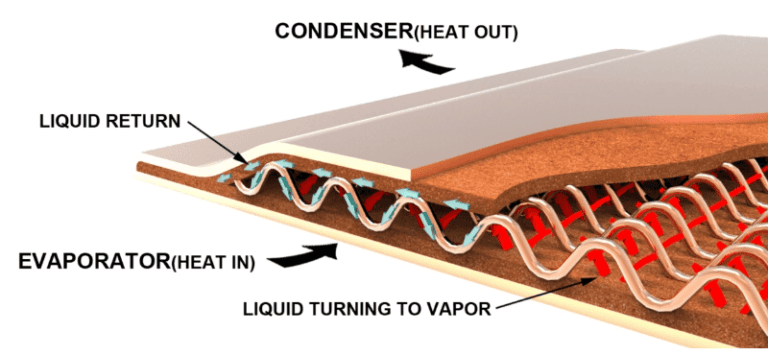
Vapor chamber cooling refers to the use of a vapor chamber as the heat-spreading component within a larger thermal solution. A vapor chamber does not remove heat on its own. It distributes heat away from a concentrated source and spreads it across a larger surface area, allowing a heat sink, cold plate, or airflow to dissipate it more effectively. Inside the sealed chamber, a working fluid absorbs heat at the evaporator region and vaporizes. The vapor travels laterally through the internal vapor space to cooler regions, where it condenses and releases heat to the attached cooling structure. A wick then returns the condensed liquid to the heat source via capillary action, repeating the cycle. By reducing conduction losses in the base and minimizing hot spots, vapor chamber cooling improves temperature uniformity, increases cooling efficiency, and lowers overall thermal resistance within the assembly.Vapor Chamber Technology
While vapor chambers operate on the same principles as heat pipes, their planar geometry and vapor cross-section enable different spreading characteristics. Manufacturing traditional vapor chambers involves two stamped metal plates that mirror each other in shape, allowing for a range of designs from a basic square to more complex configurations. They typically don’t exceed 400mm for electronics cooling applications; they can be made as wide as 150mm, offering an expansive surface area from which to dissipate heat. Additionally, each of the two plates can have embossments or reliefs stamped into the design, allowing the device to better accommodate variations in component height along the PCB.
The increased design flexibility of vapor chambers makes them more versatile for various applications. However, their manufacturing process is more complex, resulting in higher production costs compared to heat pipes, which begin production as a simple tube. Recently, a new method of vapor chamber production has emerged, which has significantly reduced both manufacturing complexity and cost (more on this later). The wick options for vapor chambers are identical to those of heat pipes, including sintered, grooved, and mesh/bundled fiber wicks.
As vapor chambers are usually chosen for their superior performance versus heat pipes, sintered wicks are the most commonly used structure. Specifically, water-based vapor chambers with a copper enclosure and copper sintered wick are the most prevalent. Using two stamped plates in the manufacturing process, the wick design within a single vapor chamber can be more intricate, allowing for a device that is precisely tailored to a specific application. The most highly customizable wick structure, a sintered wick, can include various design features within a single device, such as:
- Variation in wick thickness – wick structures generate capillary pressure to return liquid to the evaporator.
- Increasing their thickness provides more pumping power, but at the expense of vapor transport cross-sectional area.
- Variation in wick porosity/permeability – Increasing the pore spacing in between the sintered material results in a less densely packed structure, allowing water to move through it more easily. This is beneficial in applications requiring operation against gravity.
- Ability to shape the wick in certain sections of the device – some applications require a vapor chamber that is capable of moving a high volume of liquid back to the evaporator (thicker wick) while lowering evaporator resistance to improve overall performance. Here, the wick section at the evaporator is either thinned or has grooves in it, allowing the liquid to vaporize more easily. As the lower evaporation delta-T is counted in the overall heat sink delta-T, total thermal performance is improved.
- Wick installed
- Spacer added
- Assembly diffusion bonded
- Evacuated, fluid-filled, and hermetically sealed
Types of Vapor Chambers
There are several categories of vapor chambers, each with its own advantages and disadvantages. These include the traditional ‘two-piece’ design, a lower-cost ‘one-piece’ alternative, ultra-thin vapor chambers, and machined vapor chambers. All operate under the same principles and offer the same material and fluid choices, but are used for different application challenges.Versatile Two-Piece Vapor Chamber
The type of vapor chamber discussed to this point is the traditional variety that uses two stamped plates, thus the ‘two-piece’ moniker.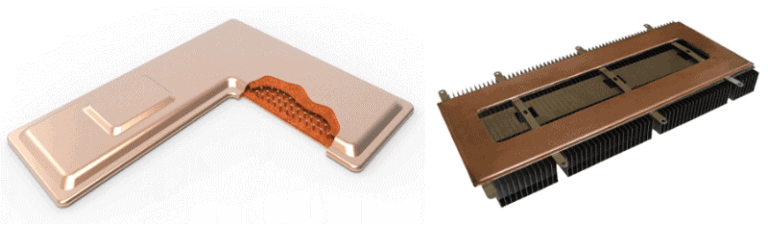 The advantages of traditional vapor chambers are:
- Direct contact with the heat source removes the base-plate layer of thermal resistance found in most heat pipe applications.
- High degree of flexibility in shape. Shapes are determined by the application requirements and PCB board layout, yet tempered by the inherent limitations of the metal stamping process. The precise shape is usually dictated by the need to maximize surface area while avoiding other components on the PCB.
- Easily incorporate through holes along the outer edge or even in the middle of the device provides for flexible mounting options to the PCB.
- High degree of flexibility of wick design within a single device. Varying wick thickness, wick porosity, and wick shape within a single vapor chamber optimizes the trade-offs in operational characteristics such as power handling capacity (Qmax), the ability of the device to transport working fluid against gravity, the ease with which the working fluid turns to vapor at the evaporator area, and the ability to handle higher heat flux.
- Easily accessible in the market. Any heat pipe manufacturer likely also produces this type of vapor chamber, as it was the first production method used for these devices.
Low Cost One-Piece Vapor Chamber
Celsia developed a one-piece vapor chamber architecture that functions as a very large single tube while offering exceptional thermal performance and some unique design options. Starting from large diameter tube stock, a wicking structure is bonded to the inside walls using various density and porosity formulations. Then a wafer-thin perforated spacer is inserted to aid in vapor flow and increase structural rigidity. As with all two-phase devices, a liquid is added, and the device is vacuum sealed. This process requires no stamping or machining and reduces the number of secondary operations, driving costs down to near parity with heat pipe solutions.
The advantages of one-piece vapor chambers are:
- Direct contact with the heat source removes the base-plate layer of thermal resistance found in most heat pipe applications.
- Lower cost relative to 2-piece vapor chamber designs, yet still allowing higher performance than multi-heat pipe solutions for near cost parity.
- Quicker time to prototype as the production process is simpler.
- Ability to bend the device, post-production, in L and U-shapes to increase design options versus a traditional two-piece design.
- Although they are basically flattened heat pipes, these vapor chambers can be as wide as 110mm and offer a width-to-height ratio of 30:1, far exceeding the 4:1 ratio of flattened heat pipes.
Ultra-Thin Vapor Chambers
Thin and ultra-thin vapor chambers can be a 1-piece or 2-piece design and are only included as a separate category because of their increasing use in compact devices like smartphones. Thermal engineers must be careful to recalibrate their performance and design expectations when using vapor chambers below 2mm. Typical vapor chambers are generally 2.5-4mm in height, depending on size and power requirements. They are known for their ability to handle higher total power and higher heat fluxes than their heat pipe counterparts. Moving below 2mm requires some consequential changes to its physical design.- Enclosure wall thickness needs to be reduced, resulting in a weaker structure that can deform more easily.
- Sintered wicks are deposited on only one side of the internal structure to optimize the ratio of wick and vapor space.
- Mesh or bundled fiber metal wicks used in place of sintered material further reduce the angle at which the device can operate against gravity and limit the power density the VC can support.
Machined Vapor Chambers
A machined vapor chamber is a specialized design that serves as a thermal hub to which multiple heat sources, usually high-power/high-flux components, can be attached to save space and/or use a single condenser.
In this example, three heat sources are screwed to the outer walls of the device and a cold plate to another surface. Another application for machined vapor chambers is with extremely recessed heat sources that, due to high power output, require a very large block or cylinder interface with it.
3D Vapor Chamber
A relatively new addition to this category family is the 3D vapor chamber. This design aims to combine the best of heat pipes and vapor chambers. Here, the base of the heat sink is a vapor chamber with holes in the top to which open-ended heat pipes are welded. The advantage is a very large contiguous vapor space that achieves a lower delta-T than its vapor chamber plus heat pipes alternative.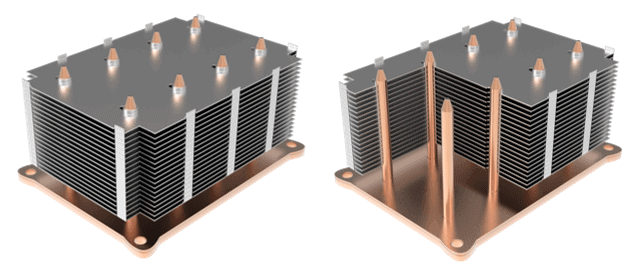 The downsides of 3D vapor chambers include large cost increases due to the complexity of the manufacturing process and how it introduces additional weld interfaces requiring structural validation.
Vapor Chamber Usage Overview
In cases where standard solid-base, finned heat sinks fail to meet thermal, mechanical, or dimensional requirements, the addition of a vapor chamber to the thermal management solution can often provide a viable solution. Typical use cases include:- Conduction-limited applications: High power density and/or high total power can cause a traditional heat sink to become conduction-limited, resulting in a high heat sink temperature rise (delta-T). Vapor chambers, with their high thermal conductivity and large surface area, can help minimize heat sink conduction losses while efficiently dissipating heat away from the evaporator.
- Specific thermal applications: In thermal applications that require several heat sources to remain at roughly the same temperature to one another (isothermal applications), vapor chambers are used.
- Space-constrained applications: In vertically space-constrained applications, the low thermal resistance of vapor chambers allows them to replace a thicker solid metal base, leaving more room for fin height.
- Limited airflow environment: In environments with limited airflow, additional horizontal fin area is required to dissipate heat, versus one with high airflow. Vapor chambers allow engineers to reduce conduction resistance in the base, allowing more even heat distribution to the fins.
- When weight is important: Furthermore, if weight restrictions apply to a device due to shock and vibration or payload requirements, a heat sink with a solid metal base may not be feasible. Vapor chamber-based heat sinks can be considerably lighter than the alternative solid metal heat sink.
Vapor Chamber Heat Sink Design & Performance
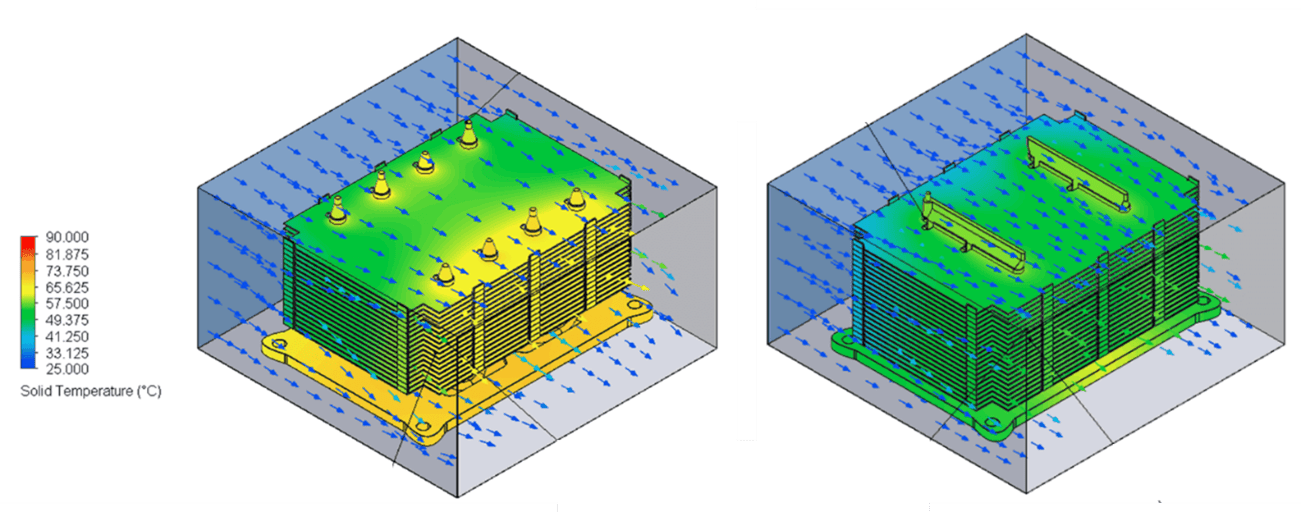
As seen in the figure below, vapor chambers can be used to spread heat to a local condenser or move it to a remote one. However, spreading heat is by far the most common use of vapor chambers. Heat pipes are usually used when heat needs to be moved to a remote condenser.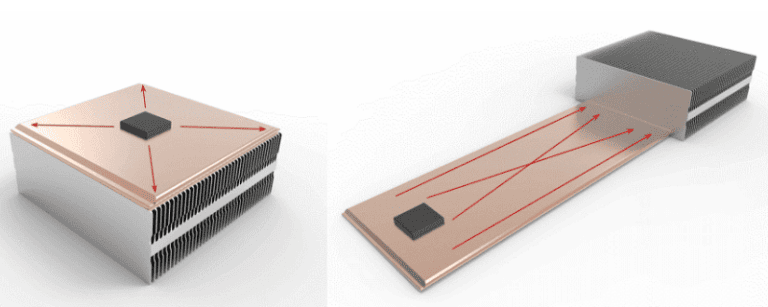 Vapor chambers can be paired with any type of heat sink. Extruded fin heat sink vapor chambers are the most common for lower power applications (~<100W) due to their relatively low cost and reasonable thermal properties. Forced air applications allow tighter fin spacing for higher power applications in order to maximize fin area. In these cases, zipper fins or fin packs are most used because of their design versatility and lower price relative to skived or bonded versions.
Vapor chambers can be attached to the fin base using a variety of methods, depending on the specific design and application requirements. Here are some common approaches:
Vapor chambers can be paired with any type of heat sink. Extruded fin heat sink vapor chambers are the most common for lower power applications (~<100W) due to their relatively low cost and reasonable thermal properties. Forced air applications allow tighter fin spacing for higher power applications in order to maximize fin area. In these cases, zipper fins or fin packs are most used because of their design versatility and lower price relative to skived or bonded versions.
Vapor chambers can be attached to the fin base using a variety of methods, depending on the specific design and application requirements. Here are some common approaches:
- Soldering: The most common approach is to use solder to attach the vapor chamber to the fin base. Soldering provides a strong bond and good thermal conductivity but requires the device to be nickel-plated for solder compatibility. Solders that melt at lower temperatures are preferable because higher temperature alternatives may cause the vapor chambers to deform unless it is encased in a solder jig.
- Adhesive bonding: One common approach is to use a thermally conductive adhesive to attach the vapor chamber to the fin base. This approach is relatively simple and can be used with a wide range of fin base materials; however, it is the least thermally efficient.
- Mechanical attachment: Mechanical attachment methods include using screws, clips, or clamps to attach the vapor chamber to the fin base. This approach provides the most secure connection to meet challenging shock and vibration requirements.
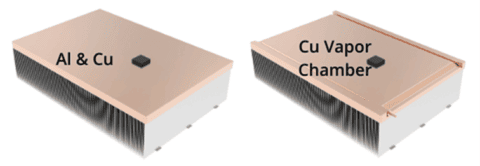 The thermal resistance for the aluminum and copper are 0.587 oC/W and 0.382 oC/W, respectively, while the vapor chamber design is 0.260 oC/W. Further, while the aluminum and vapor chamber heat sinks are roughly the same weight, the solid copper heat sink is nearly twice as heavy. To more closely compare the thermal performance of a vapor chamber heat sink to a solid metal heat sink, visit our online heat sink calculator and usage instructions for that calculator. In the second example, a heat pipe-based heat sink is compared to one with a vapor chamber in an application where the fin stack is remote to the heat sink base. For this 250W application, the heat pipe solution has a delta-T of 54 oC while the vapor chamber heat sink registers at just under 39 oC.
Vapor chambers are well-suited for conduction-limited, high-power density, or space-constrained applications. When properly integrated into a thermal assembly, they reduce spreading resistance and improve temperature uniformity while maintaining mass efficiency.
The thermal resistance for the aluminum and copper are 0.587 oC/W and 0.382 oC/W, respectively, while the vapor chamber design is 0.260 oC/W. Further, while the aluminum and vapor chamber heat sinks are roughly the same weight, the solid copper heat sink is nearly twice as heavy. To more closely compare the thermal performance of a vapor chamber heat sink to a solid metal heat sink, visit our online heat sink calculator and usage instructions for that calculator. In the second example, a heat pipe-based heat sink is compared to one with a vapor chamber in an application where the fin stack is remote to the heat sink base. For this 250W application, the heat pipe solution has a delta-T of 54 oC while the vapor chamber heat sink registers at just under 39 oC.
Vapor chambers are well-suited for conduction-limited, high-power density, or space-constrained applications. When properly integrated into a thermal assembly, they reduce spreading resistance and improve temperature uniformity while maintaining mass efficiency.