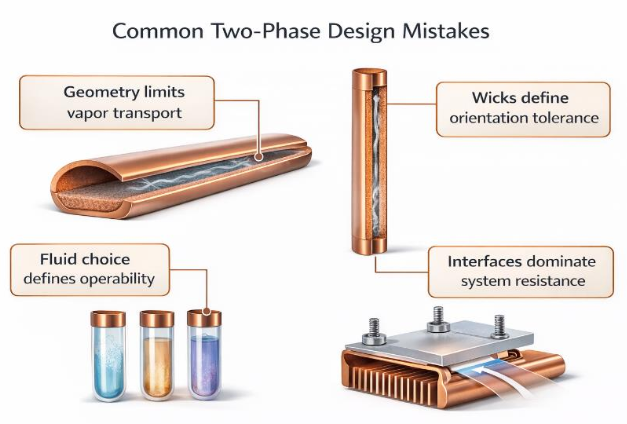
Performance is not optimized it is allocated. Every constraint spends margin somewhere. If you don’t know where, physics will decide for you.
A 20–30% hit in thickness commonly changes the governing limit.
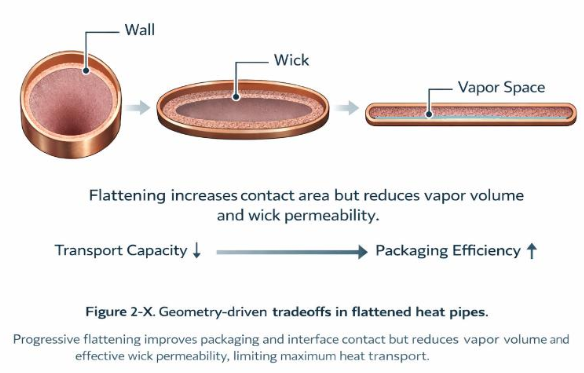
Flattening is a trade, not a win.
Flattened height ≤50–60% of OD is where vapor transport and wick effects take over.
Capillary limit kills more designs than anything else.
Punishments
In real hardware, the capillary limit is often the governing limit.
Vapor space is not optional.
Long + thin + flat becomes vapor-limited. Always.
Length eats capillary pressure for lunch.
If L/OD looks uncomfortable on the drawing, it already is.
The hottest square centimeter sets the ceiling.
Most systems are not heat-pipe-limited.
Vapor cross-section sets capacity.
Liquid return sets robustness.
Everything else is tuning.
Break these rules and the device may still work
but it will not be a high-performance solution.