
How Do Heat Pipes Work?
Heat Pipes 101: Construction, Working Principle, and Performance
How do heat pipes work? A heat pipe moves heat through a continuous phase-change cycle inside a sealed envelope: working fluid evaporates at the hot end (evaporator), travels as vapor to the cold end (condenser), condenses to liquid, and returns by capillary action through a wick. The cycle is passive: no pump, no moving parts.
In two-phase electronics cooling, this passive cycle delivers effective thermal conductivities one to two orders of magnitude above solid metals, the heat pipe working principle behind most high-power-density designs. This article covers electronics-scale heat pipes; HVAC heat pipes use related physics at different scales and are out of scope here.
What Is a Heat Pipe? Three-Part Construction
At the simplest level, a heat pipe is a vacuum-sealed metal tube with a wick on its inner walls and a small charge of working fluid. Three essential parts:
- Envelope: Vacuum-sealed metal tube, almost always copper for electronics cooling, typically 2 to 12 mm in diameter. The vacuum lets water boil at room temperature.
- Wick: A capillary structure bonded to the inside wall, most often sintered copper powder. It returns liquid from the condenser to the evaporator.
- Working fluid: A small charge that cycles between liquid and vapor. De-ionized water dominates the roughly 5 to 80 °C range that covers most electronics.
By a large margin, the most common configuration is copper envelope, sintered copper wick, and de-ionized water, the copper-water heat pipe that dominates electronics cooling. Heat pipes can be flattened to roughly half their diameter and bent in any direction; both impose a Qmax derating. These dimensions and fluid choices are application-tuned in our heat pipe technology.
The Heat Pipe Working Principle: Evaporator and Condenser in Continuous Cycle
How do heat pipes work step by step? The heat pipe working principle is a four-step cycle that runs continuously while a temperature difference exists between the two ends. The same cycle answers “how does a heat pipe work” regardless of geometry or working fluid.
- Heat input at the evaporator. Working fluid in the wick absorbs incoming heat and turns to vapor. Water’s latent heat of vaporization is roughly 2,260 kJ/kg, five times the energy needed to bring water from 0 to 100 °C.
- Vapor flow. Evaporation locally raises pressure; vapor flows from evaporator to condenser through the open vapor space at tens or hundreds of meters per second.
- Condensation at the condenser. Vapor contacts the cooler wick and condenses, releasing latent heat into the envelope wall. The wall conducts heat to the cooling solution beyond: fin pack, cold plate, or enclosure wall.
- Liquid return. Condensed liquid is wicked back to the evaporator by capillary force. The cycle repeats.
The process is passive. The only fuel is the temperature difference between the two ends.
The capillary action that drives liquid return is the same principle that soaks a paper towel completely if a single corner is dipped in water.
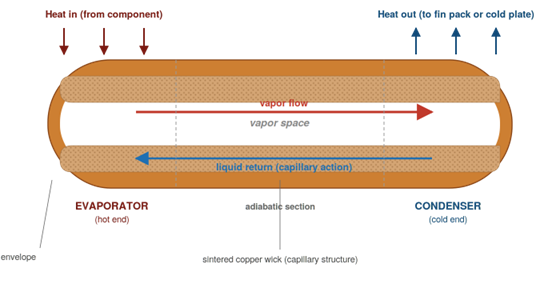
Cross-section diagram of a two-phase heat pipe showing the evaporator at one end, vapor flow through the central vapor space to the condenser, and liquid return via capillary action through the sintered wick.
Our online heat pipe calculator estimates Qmax by pipe size, fluid, and orientation.
Heat Pipe Thermal Conductivity: Why Phase Change Beats Solid Metal
Aluminum conducts heat at roughly 180 W/m·K, copper at roughly 400 W/m·K. A well-designed heat pipe delivers effective thermal conductivities from 1,500 to over 60,000 W/m·K, one to two orders of magnitude above solid metal.
Heat pipe effective thermal conductivity is not a fixed material property; it depends on length, diameter, working fluid, wick design, and operating temperature. Longer heat pipes deliver higher effective thermal conductivity, the opposite of solid conductors. Our heat pipe thermal conductivity deep dive covers the length-versus-conductivity relationship with measured data.
Heat Pipe Effective Thermal Conductivity as Function of Length
The mechanism explains the gap. Solid-metal conduction relies on fixed-rate phonon transport. Phase change carries heat as mass: every gram of vaporized fluid carries thousands of joules of latent heat to the condenser. Longer pipes cycle more mass through, and effective conductivity rises until a performance limit intervenes.
This enables tight thermal budgets (often under 40 °C between Tcase max, or Tjunction max for bare-die ICs, and Tambient max), height-constrained heat sinks, weight-constrained designs, and high-power-density components where solid bases cannot spread heat fast enough. Our thermal resistance fundamentals primer covers full delta-T accounting.
Wick Structures, Working Fluids, and Performance Tuning
Three wick structures dominate electronics cooling heat pipes:
| Wick type | Capillary strength | Cost | Typical use |
| Sintered powder | High, works against gravity | Higher | Defense, aerospace, any-orientation electronics |
| Mesh / screen | Moderate | Lower | Cost-sensitive, gravity-assisted or horizontal |
| Grooved | High permeability, limited capillary lift | Moderate | Space applications, horizontal designs |
Working fluid sets the operating temperature window:
| Working fluid | Temperature range | Common use |
| De-ionized water | ~5 to 200 °C | 90%+ of electronics cooling heat pipes; copper envelopes |
| Methanol | -40 to 200 °C | Low-temperature electronics, military; copper envelopes |
| Acetone | -30 to 150 °C | Aluminum envelopes, alternative low-temp fluid |
| Ammonia | -50 to 100 °C | Spacecraft, high-Qmax aerospace; aluminum envelopes |
Wick and fluid choices set Qmax. Sintered wicks support adverse orientations; grooved wicks support horizontal designs. Wall thickness, porosity, permeability, and fluid loading are all application-tuned.
Heat Pipe Performance Limits Every Engineer Should Know
How do heat pipes work near their bounds? Five classical performance limits define the operating envelope, and whichever is reached first sets Qmax.
- Capillary limit: The most common in practice. The wick cannot keep up with vaporization, the evaporator dries out, and the pipe stops. Sets Qmax for most electronics heat pipes.
- Boiling limit: At very high local heat flux, the wick loses its liquid film and a vapor blanket forms, making the pipe thermally non-linear. Common at high-flux evaporators.
- Sonic limit: At low operating temperatures, vapor flow can reach Mach 1, choking mass flow. Mainly relevant for sodium or potassium heat pipes; occasionally methanol or ammonia during cold startup.
- Entrainment limit: At very high vapor velocities, liquid droplets tear off the wick and block return. A concern in high-Qmax aerospace designs.
- Viscous limit: At very low operating temperatures, vapor viscous forces dominate. Relevant during cold startup.
Orientation interacts directly with the capillary limit. Gravity-assisted is the easy case; horizontal is the standard reference; against-gravity derates Qmax sharply. A typical 8 mm sintered water heat pipe carries roughly 127 W gravity-assisted, 68 W horizontal, and 8 W against full gravity (-90°), with functional length for vertical against-gravity operation around 150 mm. Bending heat pipes and how it affects performance covers geometry-related derating.
When to Choose Heat Pipes: Application Signals
What are heat pipes useful for in real designs? Five signals tell you when a two-phase heat pipe is the right tool:
- Heat must move more than 50 mm from source to condenser. Below that distance, solid copper competes at lower cost.
- Fin array footprint is more than 10x the heat source footprint. Solid-base spreading becomes the bottleneck.
- Solid copper meets the thermal target but fails on weight, shock, or vibration. Two-phase devices reduce mass and survive harsher conditions.
- Thermal budget (Tcase max minus Tambient max) is below 40 °C. Tight budgets, especially with low airflow, almost always mean two-phase.
- Form factor is height-constrained. Heat pipes free up vertical space taller fins would consume.
Typical applications: GaN RF amplifiers, AESA radar arrays, and aerospace avionics. Our Qmax calculator, heat sink size calculator, and heat sink performance calculator handle first-pass evaluation; the heat pipe design guide covers specification.
Heat Pipes vs. Vapor Chambers: Same Physics, Different Geometry
Both heat pipes and vapor chambers use the same heat pipe working principle. Vapor chambers are sometimes called planar heat pipes.
The practical distinction is geometry. Heat pipes are tubular (up to about 4:1 width-to-thickness when flattened); vapor chambers are planar (up to about 60:1). Use heat pipes to move heat to a remote condenser, vapor chambers to spread heat across a large local fin array.
Vapor chambers also allow direct heat-source contact, removing one stack interface, which helps in high-flux applications. Our heat pipes vs vapor chambers comparison covers the full decision tree.
Frequently Asked Questions About Heat Pipes
Do heat pipes need power to operate?
No. A heat pipe is entirely passive; the only fuel is the temperature difference between the evaporator and condenser.
How long do heat pipes last?
Properly designed heat pipes routinely last 20-plus years. Failure modes (non-condensable gas, wick degradation, corrosion) are mitigated by good materials and clean processing. Celsia performs 100% helium leak testing and burn-in on every pipe.
Can heat pipes work in any orientation?
Yes, with caveats. Gravity-assisted is the easy case; horizontal is standard; against-gravity derates Qmax. Sintered wicks handle adverse orientation best.
How much better than copper are heat pipes really?
Roughly 10x to 100x in effective thermal conductivity, depending on geometry. Copper conducts at a fixed 400 W/m·K. Heat pipes deliver effective conductivities from 1,500 to over 60,000 W/m·K along the pipe’s length, within its Qmax envelope.
What information does an engineer need before specifying a heat pipe?
Heat load (W), heat flux (W/cm²), orientation, length and bend constraints, ambient range, qualification requirements (MIL-STD, ITAR, RoHS, REACH), and thermal budget. How heat pipes work in your specific design depends on how these inputs interact. Request an engineering review to start.
This article was originally written by Marc Demars. Marc was VP of Marketing and Business Operations for Celsia from 2007 to 2025. Marc passed in 2025 and he is greatly missed, but lives on through his article contributions.