A heat pipe is a passive, two-phase heat transfer device that moves large amounts of heat with minimal temperature difference. It forms the backbone of most of our thermal solutions, enabling compact designs that outperform conventional solid-metal heat sinks. Each pipe operates through the evaporation and condensation of a working fluid in a vacuum-sealed envelope, creating an exceptionally efficient thermal pathway.
We use heat pipes when standard aluminum or copper sinks can’t meet conduction or spreading requirements. Their effective thermal conductivity, often exceeding 10,000 W/m·K, combined with shape flexibility and long service life, makes them ideal for transferring heat from the source to a remote condenser or fin stack.
Heat Pipe Technology
To understand heat pipe technology, it is essential to examine its three core components: the enclosure material, wick structure, and working fluid.
Heat Pipe Enclosure / Envelope Material
The enclosure is a vacuum-sealed vessel (tube or envelope) that houses both the working fluid and wick structure. It transports heat away from the semiconductor in vapor form and returns the condensed liquid via the wick. Copper is the most commonly used enclosure material, followed by aluminum, with stainless steel and titanium reserved for applications requiring specific compatibility or durability. Wall thickness is selected based on structural integrity needs and space constraints.
Heat Pipe Wick Structure
The wick lines the inner wall and returns liquid to the evaporator. Different wick structures offer varying abilities to handle higher power densities and move the working fluid against gravity when the evaporator is above the condenser.
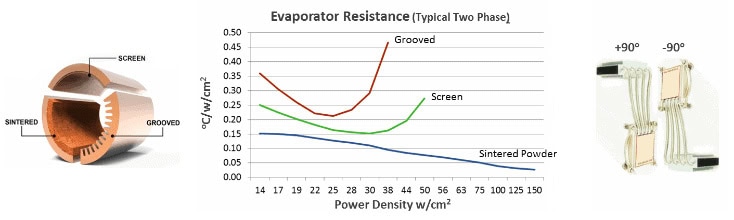
| Power Density | Resistance | Orientation | |
| Sintered Powder | <500w/cm² Good for freeze/thaw and bent shapes Small heat sources up to 1,000w/cm² |
0.15-0.03 °c/w/cm² |
+90° to -90° |
| Screen | <30w/cm² Main use is for very thin heat sinks due to high evaporator resistance. Limited bending. |
0.25-0.15 °c/w/cm² |
+90° to -5° |
| Grooved | <20w/cm² Entry-level price/performance; must be gravity-aided or neutral. |
0.35-0.22 °c/w/cm² |
+90° to 0° |
Common Wick Types
Sintered Wick: Formed by fusing powdered copper at high temperatures, similar to brake pad manufacturing. Performs well under high heat flux and against gravity, offering broad design flexibility.
Screen / Mesh or Braided Wick: Made from screen mesh or braided copper strands. Ideal for ultra-thin applications and shallow angles, but less effective at higher heat fluxes.
Grooved Wick: Integrated into the extruded pipe structure for a low-cost option. Best for gravity-aided or level applications.
Working Fluids Used in Heat Pipes
Phase change of the working fluid from liquid to vapor and back enables heat pipes to achieve thermal conductivities far higher than solid metal. Fluid choice depends on:
- Fluid Figure of Merit (FOM), which factors in key temperature-dependent variables: latent heat of vaporization, surface tension, liquid density, and liquid viscosity.
- Min/max temperature of the liquid during operating and non-operating conditions.
- Safety, specifically toxicity or flammability.
- Cost.
The FOM (second column in the table below) compares how well different liquids perform as working fluids. It is a score that indicates which liquid moves heat more effectively. The higher the figure, the better. To calculate FOM, divide the effective thermal conductivity of the working fluid by its vapor pressure at the operating temperature.
| Working Fluid | Operating Temperature Range (°c) | Figure of Merit | Surface Tension (mN/m) | Thermal Conductivity (W/mK) | Potential Concerns |
Compatible Enclosures
|
| Water | 0 to 200+ | 140 | 72 | 0.606 | Operation at low temperature |
Copper, nickel, titanium
|
| Ammonia | -50 to 120 | 115 | 28.9 | 0.525 | Toxic, expensive |
Aluminum, stainless steel
|
| Methanol | -40 to 200 | 80 | 22.6 | 0.138 | (Less) toxic, flammable |
Copper, stainless steel
|
| Acetone | -30 to 150 | 70 | 23.2 | 0.163 | Highly flammable, toxic |
Aluminum, stainless steel
|
Once the correct working fluid is selected, a compatible enclosure follows. Both water and methanol heat pipes are compatible with copper enclosures, while ammonia and acetone variants use aluminum. Mixing incompatible materials shortens service life.
Heat Pipe Working Principles
Thermal Conductivity: Heat pipe thermal conductivity ranges from roughly 1,500 to 60,000 W/(mK) in practical terms, compared to ~180 W/(mK) for aluminum and ~400 W/(mK) for copper. The reason for the increase over solid copper at the low end of that range is that vapor is an exceptionally effective heat transfer medium. The variability (or “effective thermal conductivity”) for a given diameter is mainly explained by length. Because vapor transfers heat so efficiently, the temperature delta between evaporator and condenser is nearly the same for a short unit as for a long one, which increases effective thermal conductivity proportionally. See Celsia’s online heat pipe calculator for precise figures on effective thermal conductivity and maximum heat carrying capacity (Qmax).
Capillary Action: When the evaporator is at or above the condenser, capillary action returns working fluid from the condenser to the evaporator. This uses the inherent surface tension of the fluid to continuously move toward a drier portion of the wick. The same principle is visible when a paper towel is partially dipped in water.
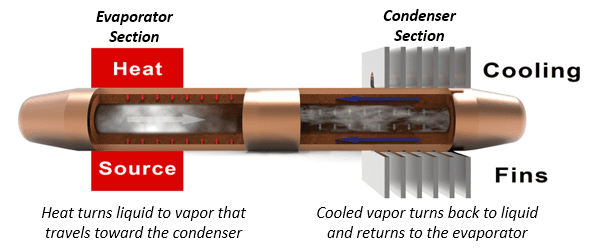
Two-Phase Heat Transfer Cycle: As heat is applied to one end, some liquid working fluid turns to vapor and travels toward lower-pressure cooling fins. Because the device operates under partial vacuum, vaporization occurs well below the fluid’s standard boiling point. At the condenser end, vapor cools, returns to liquid, is absorbed by the porous wick, and is transported back to the heat source via capillary action. In steady state, the cycle repeats continuously.
Operating and Non-Operating Temperatures: The working fluid determines the operating range. Water heat pipes run between 0°C and 200°C. Above 200°C, rising internal vapor pressure risks structural damage. Below the rated temperature, the frozen liquid at the evaporator melts and turns to vapor. The cold condenser then causes that vapor to freeze at the condenser end, eventually drying out the evaporator and risking component overheating. Operation returns to normal once ambient temperature rises above freezing. Freeze/thaw cycles are generally not a problem for sintered-wick designs.
Expected Lifespan: Infant mortality is the most common failure point. We eliminate this through 100% burn-in testing combined with helium leak testing. Heat pipes that operate within design parameters, use quality materials, and are manufactured under a controlled process will typically last 20 or more years.
Types Of Heat Pipes
Constant Conductance Heat Pipes (CCHP): Standard heat pipes with fixed thermal conductance between evaporator and condenser. The most commonly used configuration.
Other Types:
- Vapor Chambers: Spread heat across a large surface area; ideal for flat baseplates. Include internal supports to maintain vapor space.
- Variable Conductance Heat Pipes (VCHP): Include non-condensable gas to modulate thermal conductance based on ambient conditions.
- Thermosiphons: Rely on gravity; no wick in some cases. Handle higher Qmax than standard devices.
- Loop Heat Pipes: Handle long distances and any orientation; more expensive due to complexity.
- Rotating Heat Pipes: Designed for spinning systems like RF rotary joints; use spiral-grooved wicks.
- Oscillating Heat Pipes: Excel at transferring heat over long distances and against gravity.
When to Use Heat Pipes
Heat pipe technology is ideal when solid metal heat sinks fall short in thermal or mechanical performance.
Key Applications:
- High power density / total power: Reduces delta-T by improving conduction.
- Space-constrained designs: Moves heat to a remote condenser.
- Limited airflow: Improves conduction from the heat source to the fins, lowering thermal resistance.
- Weight-sensitive systems: Replaces heavy solid bases with lightweight two-phase options.
Designers must carefully consider shape, mounting method (direct vs. indirect contact), and heat pipe type to optimize performance and cost.
Heat Pipe Performance
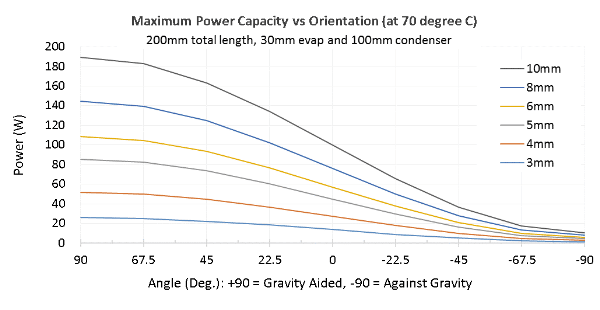
Qmax (maximum heat-carrying capacity) generally increases with pipe diameter. Each wick type can be tuned to optimize specific performance parameters, and this is especially true of sintered wicks. Celsia’s online heat pipe calculator and use instructions calculate Qmax at different orientations, effective thermal conductivity, and temperature rise (delta-T) for various diameters.
The chart below graphs Qmax for typical sintered-wick heat pipes of varying diameters against required operating orientation. The grey line represents a 10mm pipe optimized for maximum Qmax when flat (0-degree orientation). Qmax increases as the evaporator moves below the condenser, and decreases in the opposite direction, with drops of up to 95% from one orientation extreme to the other. Internal structure can be adjusted to optimize for specific conditions: wick thickness, porosity, and fluid volume are all tunable.
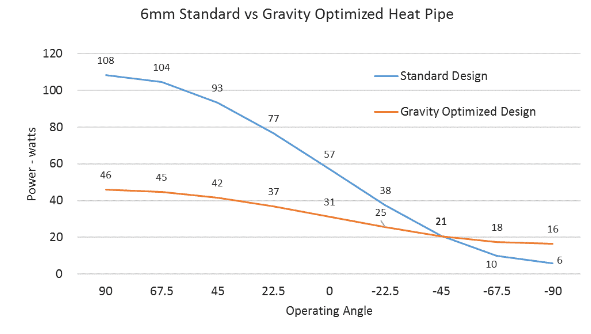
When a heat pipe must operate between -50 and -90 degrees, the wick can be optimized to increase capillary pumping. A gravity-optimized 6mm unit then outperforms its non-optimized 6mm counterpart in that range, though its Qmax is lower than the non-optimized version above -45 degrees.
Heat Pipe Bending & Flattening
One practical advantage of custom heat pipes is their flexibility. Flexible heat pipes can be shaped into virtually any form by bending and/or flattening, subject to certain parameters. The typical minimum bend radius is 3x the tube diameter. However, bending a heat pipe reduces Qmax: smooth, gradual bends have less effect than tight ones, but as a rule, every 45-degree bend decreases Qmax by approximately 2.5%.
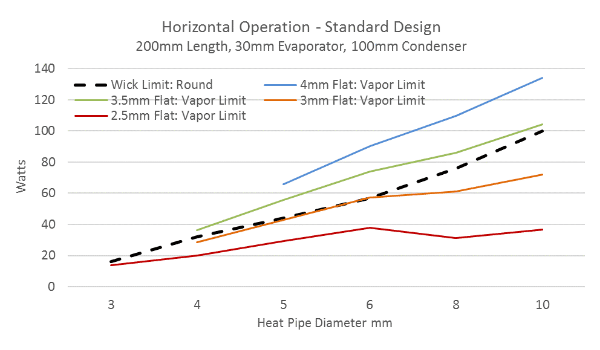
Flattening a sintered heat pipe to one-third of its original diameter is generally the maximum, though this figure decreases for smaller pipes (2-4mm) and increases for larger ones (>10mm). Ultra-thin heat pipes can be produced using other wick structures. The chart below shows how flattening affects performance. Qmax is determined by the lower of the wick limit or vapor limit. For a round 6mm standard unit, the wick limit is just under 60 watts. Flattening to 4, 3.5, or 3mm has no effect since the vapor limit remains above the wick limit. Note that flattening an 8 or 10mm pipe to 3mm or 2.5mm will substantially reduce Qmax.
Custom Heat Pipes
Off-the-shelf heat pipes cover many standard applications, but custom heat pipes are often required when designs push the edges of power density, form factor, or environmental constraints. We engineer custom heat pipes from the inside out, tuning wall thickness, wick thickness, porosity, permeability, and fluid loading to the specific demands of each project. Whether the application calls for miniature diameters, aggressive bends, gravity-adverse orientations, or extreme temperature ranges, a purpose-built solution consistently outperforms a catalog part.
Build Your Solution
Heat pipe technology delivers unmatched thermal conductivity, shape flexibility, and long-term reliability. It is the right choice for electronics requiring high-performance thermal management in compact, complex, or passive environments. Despite a higher initial cost than solid metal alternatives, the performance advantages justify use in applications with high power densities, tight spatial constraints, or challenging orientations. When standard configurations aren’t enough, loop heat pipes, vapor chambers, and oscillating heat pipes expand the design envelope further.
At Celsia, we’ve built our practice around heat pipe and two-phase thermal solutions. Our engineering team is available to help you select the right configuration, work through thermal tradeoffs, and deliver a validated design that meets your program requirements.