Applications / Avionics

Avionics Cooling & Thermal Management

Custom two-phase thermal solutions for mission computers, radar processors, communications electronics, and airborne systems

Overview

Avionics thermal management is increasingly demanding as systems continue to increase in processing capability while available space, weight, and cooling capacity remain constrained. Mission computers, radar processors, electronic warfare systems, communications equipment, and autonomous flight computing platforms increasingly operate within sealed or conduction-cooled environments where airflow is limited or unavailable, placing greater emphasis on passive heat spreading and heat transport.

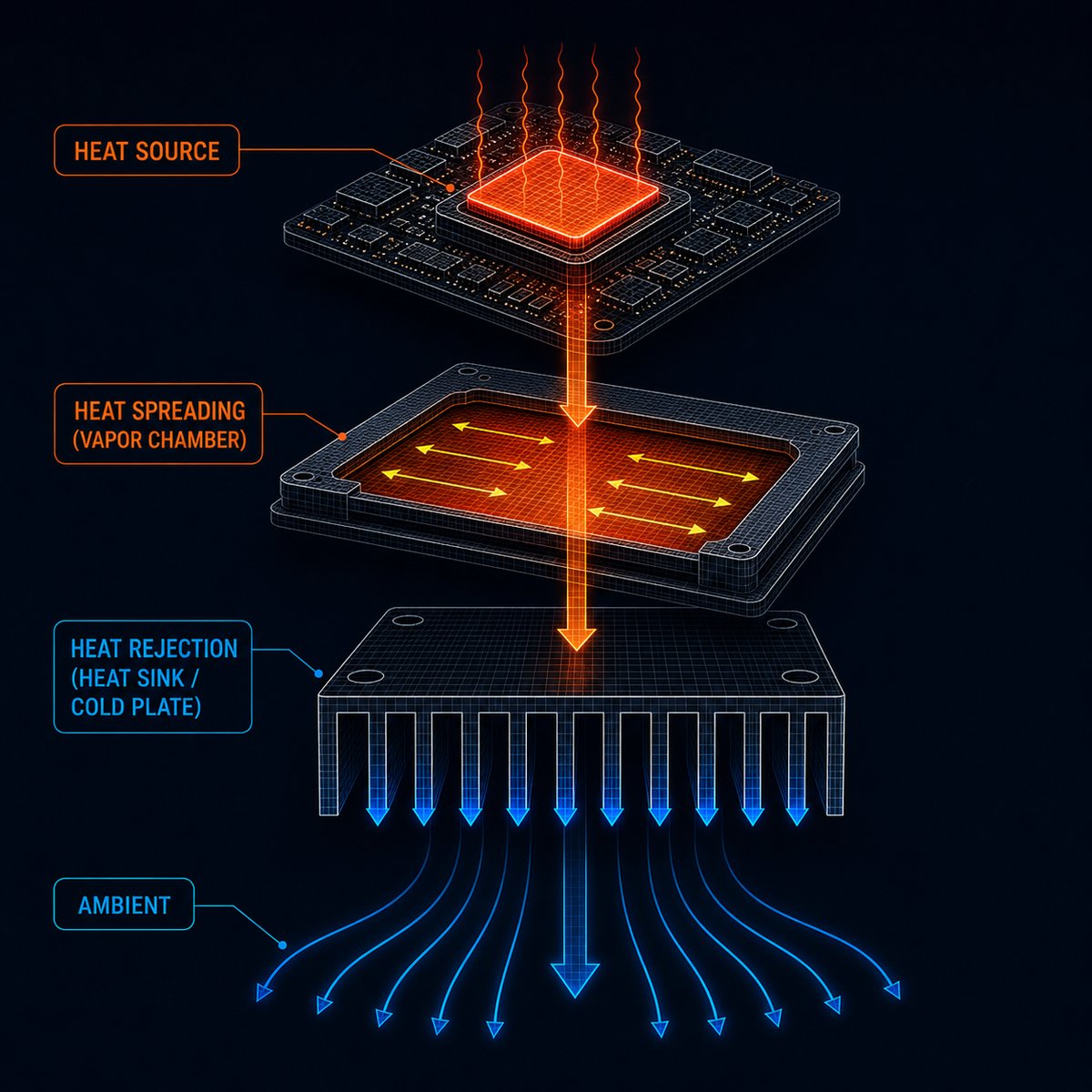
As processor power increases, thermal performance is increasingly determined by the system’s ability to spread heat away from localized hot spots, transport that heat to available aircraft structures, and ultimately reject it through the aircraft’s thermal management architecture. Successful avionics cooling requires understanding the complete thermal path, not just the component generating heat.

Thermal challenges

Thermal Challenges in Avionics Systems

Many avionics cooling challenges stem from the same fundamental problem. Electronics power density continues to increase while mechanical envelopes, weight budgets, and available cooling resources remain largely fixed.

In many systems, a relatively small number of processors, FPGAs, power devices, or RF amplifiers generate the majority of the thermal load. Identifying these dominant heat sources is often more important than reducing the average enclosure temperature.

ChallengeThermal Impact
Higher processor, FPGA, and RF power densityIncreased heat flux and localized hot spots
Sealed or conduction-cooled enclosuresLimited airflow and reduced cooling options
SWaP-C requirementsReduced thermal mass and restricted packaging volume
High-altitude operationLower convective heat transfer capability
Vibration and shock environmentsIncreased demands on interfaces and structures
Long operational life requirementsPreference for passive, highly reliable solutions

As heat loads continue to rise, thermal management for avionics must efficiently spread heat away from components and transport it to available aircraft thermal sinks without adding significant weight, power consumption, or maintenance requirements.

Thermal path

Common Thermal Bottlenecks in Avionics Systems

Thermal performance is often limited by one of three factors:

  1. 01

    Heat Spreading

    Processor or RF junction temperatures rise despite acceptable chassis or heat sink temperatures

  2. 02

    Heat Transport

    Heat cannot efficiently reach the aircraft structure or available rejection surface

  3. 03

    Heat Rejection

    Aircraft thermal sinks cannot absorb additional heat under worst-case operating conditions

Determining which bottleneck dominates the system is often the first step in selecting an effective cooling architecture.

Many avionics systems become thermally constrained by heat spreading and heat transport long before overall aircraft heat rejection capacity is reached. Identifying and reducing those limitations is often the fastest path to improving thermal performance.

Exploded thermal path: heat source on a circuit board, vapor chamber heat spreading, heat sink or cold plate heat rejection, and ambient.
Heat source → spreading → rejection → ambient.

Applications

Common Avionics Applications & Cooling Architectures

01

Mission Computers & VPX/OpenVPX Systems

Typical thermal challenge

High-power processors, FPGAs, and AI accelerators concentrated within conduction-cooled chassis

Why the architecture is used

Vapor chambers reduce spreading resistance beneath high-power devices while heat pipes transport heat to chassis walls, cold plates, and aircraft structures

02

Radar & Electronic Warfare Electronics

Typical thermal challenge

High heat flux from GaN amplifiers and dense processing hardware

Why the architecture is used

Two-phase devices move heat away from localized hot spots and distribute it across available rejection surfaces

03

Communications & Datalink Systems

Typical thermal challenge

Continuous thermal loads within compact, sealed enclosures

Why the architecture is used

Passive architectures improve reliability while transporting heat without additional power consumption

04

EO/IR & Sensor Processing Payloads

Typical thermal challenge

Limited space, vibration isolation requirements, and restricted heat rejection paths

Why the architecture is used

Thermal straps transfer heat across isolated structures without compromising vibration isolation

05

Aircraft Power Electronics

Typical thermal challenge

High total heat loads and transient operating conditions

Why the architecture is used

Heat pipes and thermosyphons manage both spreading and transport requirements while minimizing added weight

06

Autonomous Flight & Edge Computing Systems

Typical thermal challenge

High compute density combined with strict weight and power constraints

Why the architecture is used

Lightweight two-phase architectures provide thermal performance without consuming additional system power

System-level design

System-Level Thermal Design Considerations

Successful avionics cooling requires balancing component temperatures, aircraft integration constraints, environmental requirements, and available heat rejection paths.

Conduction-Cooled Architectures

Many aerospace and defense electronics systems rely on conduction cooling rather than forced-air cooling.

In these systems, junction temperature is often determined as much by interface resistance and chassis conduction paths as by the cooling device itself. Thermal interfaces, card guides, chassis walls, mounting structures, and available aircraft heat sinks collectively influence system thermal performance.

Improving the cooling device alone may provide limited benefit if interface resistance or chassis conduction paths remain unchanged. System performance is frequently constrained by the weakest portion of the thermal path.

Aircraft Heat Rejection Constraints

Unlike terrestrial electronics, an aircraft avionics cooling system is ultimately limited by the available heat sinks onboard. Structural members, cold walls, cold plates, fuel systems, environmental control systems, and external surfaces may all serve as thermal rejection paths depending on the platform architecture.

Successful thermal designs must be built around both the heat source and the available aircraft-level heat rejection capacity. Improving heat spreading and transport can reduce component temperatures, but overall performance remains dependent on the system’s ability to reject heat from the aircraft.

Environmental Conditions

Avionics cooling hardware must maintain performance through vibration, mechanical shock, altitude changes, thermal cycling, humidity exposure, and varying aircraft attitudes.

These conditions influence material selection, thermal interfaces, structural design, and cooling architecture selection.

Qualification

Qualification & Reliability Considerations

Avionics thermal management solutions must maintain performance throughout the aircraft lifecycle while operating under demanding environmental conditions.

Thermal performance, structural integrity, and environmental durability should be evaluated together to ensure the cooling solution remains effective throughout the mission profile.

Celsia designs thermal solutions to support environmental qualification efforts, including applications requiring testing to MIL-STD-810.

Common qualification requirements include:

  • Vibration
  • Mechanical shock
  • Altitude exposure
  • Thermal cycling
  • Humidity exposure
  • Long-term operational reliability

Engineering & manufacturing

Engineering, Manufacturing & Validation

Avionics cooling projects rarely begin with selecting a cooling technology. They begin by understanding the thermal path and identifying the factors limiting performance.

Celsia works with engineering teams to determine whether the primary constraint is heat spreading, heat transport, or final heat rejection. Available aircraft heat sinks, environmental requirements, qualification objectives, and integration constraints are then evaluated to develop a thermal architecture tailored to the application.

Designs are validated through thermal modeling, performance testing, and environmental considerations aligned with program requirements. Manufacturing processes are controlled to support repeatable thermal performance, full material traceability, and qualification-driven aerospace and defense programs.

Capabilities include:

  • Thermal path analysis
  • Thermal architecture development
  • Custom two-phase cooling solutions
  • Integrated thermal assemblies
  • Thermal modeling and CFD support
  • Design verification testing
  • Full material traceability
  • 100% helium leak verification
  • Qmax and thermal resistance testing
  • Production manufacturing and validation support

Request a Quote